Concrete Epoxy: the Best Coating for Your Floor in Toronto
Concrete epoxy is a coating that bonds to ground-down concrete and seals it; which one is best depends on the room. Short answer: for a garage, a full polyaspartic flake system; for a basement, a moisture barrier, an epoxy base and a polyaspartic top coat; for a commercial floor, a high-build epoxy. Plain epoxy on its own yellows in sunlight and doesn't belong outdoors; see outdoor epoxy for concrete for what we use instead. We install these across the GTA from our Oakville shop, most garages in one day, from $2,000 for a single-car garage.
Not all concrete coatings are the same — and in Ontario's climate, choosing the wrong one means peeling, cracking, or yellowing within a few years. This guide compares epoxy, polyaspartic, polyurethane, and polyurea side by side, so you know exactly which coating fits your project before you spend a dollar.


Coating Comparison: Epoxy vs Polyaspartic vs Polyurethane vs Polyurea
Each coating system has different chemistry, curing speed, and performance profile. Here's how they compare on the factors that actually matter for Ontario projects.
| Feature | Epoxy | Polyaspartic | Polyurethane | Polyurea |
|---|---|---|---|---|
| Dry Time | 24–48h | 4–6h | 12–24h | 1–4h |
| Durability | High (10–20y) | Excellent (10–15y) | Good (8–12y) | Exceptional (15–20y) |
| Odour | Strong | Minimal | Moderate | Low |
| Indoor/Outdoor | Indoor (UV topcoat) | Both | Both (with sealing) | Outdoor |
| Cold Temp Application | Limited below 10°C | Down to –18°C | Down to 5°C | Down to –40°C |
| UV Yellowing | Yes (without topcoat) | No | No | No |
| Maintenance | Low | Low | Moderate | Very Low |
| Repairability | Easy | Moderate | Easy | Challenging |
| Metallic Finishes | Yes | Limited | Possible | Rare |
| Relative Cost | $ | $$$ | $$ | $$$$ |
Compare in depth: polyaspartic, polyurethane, or polyurea full guides, or our head-to-head polyurea vs epoxy flooring comparison.
Which Coating Is Right for Your Project?
The "best" coating depends on three things: how you use the space, how long you can wait for it to cure, and whether the surface sees UV exposure or freeze-thaw cycling.
Choose epoxy if:
- You want decorative metallic or marbled finishes — epoxy holds pigment and creates the deepest, most reflective look of any coating
- The space is fully indoors (garage, basement, commercial interior) with no direct sunlight — epoxy yellows without a UV-stable topcoat
- Budget is the primary constraint — epoxy is the most cost-effective entry point for a hard, seamless floor coating
- You need an easy DIY repair later — epoxy is the most patch-friendly of the four systems
Choose polyaspartic if:
- You need the floor back fast — LabSurface rates polyaspartic for foot traffic after 24 hours at room temperature, and most garages are done in 1 day
- The space gets direct sunlight — polyaspartic is UV-stable from day one, no yellowing over years of sun exposure
- You're coating in shoulder seasons (spring/fall) — polyaspartic applies reliably down to around 5°C, while epoxy needs warmer conditions
- You want longevity with low maintenance — polyaspartic tops the durability chart for mixed indoor/outdoor use
Choose polyurethane if:
- The floor sees significant temperature swings — polyurethane is more flexible than epoxy and handles thermal expansion better
- Acoustics matter — polyurethane's slight flex reduces sound transmission compared to rigid epoxy systems
- You need chemical resistance without the extreme cost of polyurea — polyurethane handles cleaning agents, oils, and mild solvents well
Choose polyurea if:
- The project is fully outdoors or in an unheated space — polyurea applies in temperatures down to –40°C and won't peel from freeze-thaw cycles
- You need maximum impact resistance — polyurea is used in secondary containment, industrial facilities, and bridge decks for this reason
- Turnaround is critical — ask us for the cure time of the polyurea we'd use
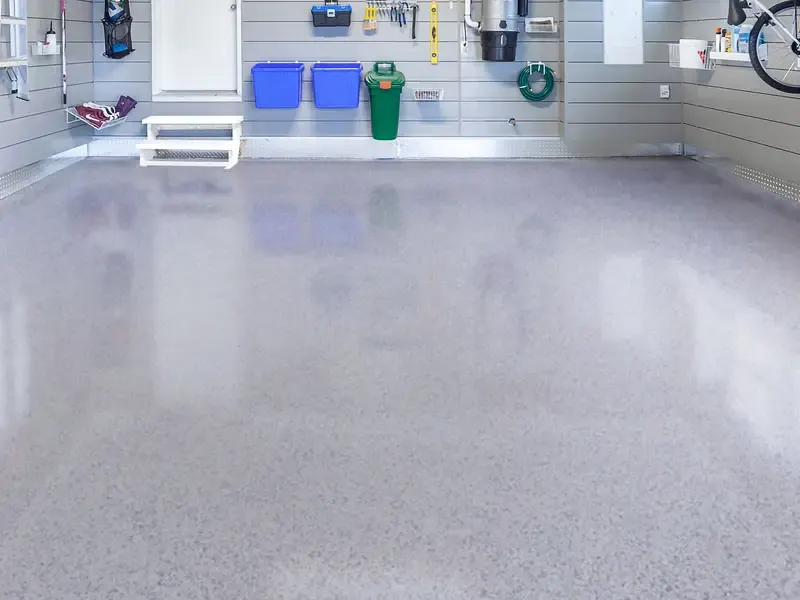
Epoxy with a polyaspartic top coat, on a real floor
Pumice Flake Garage Floor in Keswick
Keswick · Oct 2026 · 500 sq ft


The slab in this Keswick garage had extensive cracking, dark oil stains, pitting, and patches of old coating or residue. The bare concrete looked worn and uneven.
Why Ontario's Climate Changes the Calculation
Toronto and the surrounding GTA experience over 30 freeze-thaw cycles per year. When concrete transitions between frozen and thawed states, it expands and contracts. A coating that can't flex slightly with that movement will delaminate from the slab within a few winters — regardless of how well it was applied.
Standard two-part epoxy is rigid once cured. This makes it excellent for stable interior environments like heated garages and commercial interiors. But for unheated garages, outdoor pads, or driveways that see real Ontario winters, a more flexible system (polyaspartic, polyurea, or polyurethane) is the right choice.
Road salt is the other variable. Calcium chloride — used extensively in the GTA — is more aggressive than sodium chloride and attacks untreated concrete faster. Any quality coating blocks salt penetration. However, if salt-laden slush is tracked onto the floor before the coating has fully cured, adhesion can be compromised. This is why timing the installation during a dry period matters.
For garages specifically, see our garage epoxy guide which covers winter-specific prep and the polyaspartic vs. epoxy decision for attached vs. detached garages.

Best Coating by Project Type in Ontario
Based on projects completed across Toronto, Mississauga, Etobicoke, Burlington, and the broader GTA, here's what performs best in each context.
Residential Garage (heated)
→ Polyaspartic or Epoxy
Either system works well in a heated garage. Polyaspartic wins on cure speed (back in use same day) and UV stability. Epoxy wins on cost and decorative options. Most homeowners choosing metallic or colour-flake finishes go with epoxy; those wanting a quick install with minimal disruption choose polyaspartic.
Basement (finished / living space)
→ Epoxy with polyaspartic topcoat
A metallic or solid epoxy base gives you the decorative depth you want for a finished basement. Adding a polyaspartic clear topcoat provides UV stability (if there's natural light) and doubles the wear layer. This two-coat system is the most common setup for finished basements in Toronto.
Commercial / Industrial
→ High-build Epoxy or Polyurea
For warehouse units, food production, and retail spaces with heavy foot or equipment traffic, a high-build epoxy (300–500 microns DFT) is standard. For chemical containment, outdoor loading docks, or spaces that stay cold year-round, polyurea is the appropriate upgrade.
Outdoor Pads, Patios & Driveways
→ Polyaspartic or Polyurea
Standard epoxy should not be used outdoors in Ontario without a UV-stable topcoat, and even then it's marginal. Polyaspartic is the most popular choice for outdoor residential surfaces. Polyurea is used for commercial outdoor applications and areas that see heavy salt or chemical exposure.
The system going down on real jobs
Keswick · Oct 2026
Mississauga · Sep 2026
Burlington · Jul 2026
Frequently Asked Questions
Which coating dries fastest for a one-day installation?
Polyaspartic: foot traffic after about 24 hours and light traffic after 48 at room temperature (LabSurface), full cure in 2 weeks. Epoxy: foot traffic after 24 hours, full cure in about a week. Colder means longer, so we confirm when you can use the floor. Polyurea cure times depend on the product, so we give them with your quote.
Can I apply any of these coatings in winter in Ontario?
Standard epoxy requires a minimum substrate temperature of 10°C — applying it in a cold, unheated garage in February is a recipe for poor adhesion and bubbling. Polyaspartic can go down to around 5°C, and polyurea can be applied at temperatures well below freezing. If your project window is in the colder months, specify this upfront so the installer selects the right system.
What's the difference between epoxy paint and a real epoxy coating?
Epoxy paint from a hardware store is water-based with a small percentage of epoxy solids — typically 30–50%. A professional two-part epoxy floor coating is 100% solids, creating a film that's 3–5x thicker and chemically bonded to the concrete. The hardware store version will peel within a few years in a garage. A properly applied professional epoxy lasts 10–20 years.
Will epoxy yellow over time?
Aliphatic epoxies have better UV stability, but most decorative floor epoxies are aromatic and will amber or yellow under direct sunlight within 1–3 years. The standard solution is to apply a UV-stable polyaspartic or polyurethane clear topcoat over the epoxy base. This protects the colour and dramatically extends the finish's life.
How do I decide between epoxy and polyaspartic for my garage?
If your garage is heated and you want a metallic or heavily decorative finish, epoxy is the right base coat — it holds pigment better and creates more depth. If you want a solid or flake finish, need it done in one day, or the garage sees direct sunlight, polyaspartic is the better choice. Many installers now do epoxy base coat + polyaspartic topcoat for the best of both worlds.
Is DIY epoxy a good idea for Ontario garages?
Consumer DIY epoxy kits work on clean, dry concrete in ideal conditions. The problems start with moisture testing (most DIYers skip it), surface grinding (most DIY kits require it but most homeowners don't own a diamond grinder), and working time (epoxy has a pot life of 30–45 minutes, which is stressful on a 400 sq ft floor). Professional applications have a much higher success rate and much longer life expectancy. If you do go DIY, at minimum rent a floor grinder and do a plastic sheet moisture test first.
Not Sure Which Coating Is Right for Your Project?
Our Toronto team has installed all four systems across hundreds of Ontario projects. A free on-site assessment takes 20 minutes and tells you exactly what your slab needs — no upselling, no pressure.
Browse real project results in our project gallery or check our pricing guide for cost comparisons by coating type.