Quartz Epoxy Flooring Toronto: Durable Non-Slip Options for Basements & Warehouses (2026)
When slip resistance and extreme durability are the priority, quartz broadcast epoxy is the professional standard. By embedding precision-graded quartz aggregate into a 100% solids epoxy base, quartz systems create a seamless, textured surface that performs in wet basements, commercial kitchens, warehouses, and any space where safety and long-term wear resistance matter most in the GTA. Get a free quote today.

What Is Quartz Broadcast Epoxy? How It Works
Quartz broadcast epoxy is a multi-layer flooring system where natural or synthetic quartz aggregate — typically graded at 0.5–1.0 mm particle size — is broadcast (thrown by hand or with a mechanical spreader) into a wet epoxy base coat at 100% coverage. The quartz embeds into the sticky epoxy surface, creating a uniform, textured profile before the excess is swept and vacuumed away and a clear seal coat locks everything in.
The result is fundamentally different from decorative flake systems. Where flake epoxy is primarily aesthetic — colored chips broadcast for visual interest — quartz broadcast is an engineered slip- resistance system. The hardness of quartz (7 on the Mohs scale, harder than most metals) provides surface texture that does not compress or wear flat under traffic, maintaining its coefficient of friction (COF) across years of use. This is why quartz systems appear in building codes and health regulations for commercial kitchens, hospitals, pool decks, and food processing facilities.
Quartz also adds significant compressive and abrasion resistance to the base coat. A quartz-filled epoxy layer is measurably harder and more impact-resistant than a plain epoxy coat of the same thickness, which is why quartz broadcast is the preferred system for industrial floors, loading docks, and Toronto commercial warehouses where pallet jacks, forklifts, and heavy equipment operate daily.
Why Choose Quartz Epoxy Flooring in Toronto
Quartz broadcast epoxy is not the most glamorous floor coating, but it consistently outperforms other systems on the metrics that matter most for safety-critical and high-wear environments:
- •Superior non-slip grip: Quartz aggregate achieves COF values of 0.6–0.8+ wet, meeting or exceeding OSHA and Ontario building code requirements for wet commercial areas. No other decorative coating reaches this level of traction without a separate anti-slip additive.
- •Extreme abrasion resistance: The hardness of quartz means the surface resists wear from foot traffic, wheeled equipment, and dragged pallets far longer than a plain epoxy or polyaspartic coating alone.
- •Chemical resistance: The sealed quartz system resists oils, fuels, de-icers, cleaning chemicals, and food-grade acids — making it appropriate for commercial kitchens, auto shops, and manufacturing environments.
- •Moisture performance in Toronto basements: Quartz broadcast is one of the best coating systems for damp basements in the GTA because the texture profile allows any minor moisture vapor transmission to dissipate at the surface rather than building pressure under a solid film — reducing blister risk compared to high-gloss coatings on marginally wet slabs.
- •Color options: Natural quartz tones (beige, grey, tan, white) and dyed quartz colors (charcoal, red, blue, black) can be blended for custom aesthetics while maintaining the full functional performance of the system.

Where Quartz Epoxy Is Used in Toronto: Best Applications
Wet Basements
Toronto basements with seasonal humidity, sump pump areas, or utility rooms that see water on the floor benefit from quartz broadcast's wet-surface traction. The texture remains grippy even with standing water — unlike high-gloss coatings that become dangerously slippery when wet.
Commercial Kitchens & Food Service
Ontario Food Premises Regulation requires slip-resistant flooring in commercial kitchen wet areas. Quartz epoxy meets this requirement with a seamless surface (no grout lines for bacteria to accumulate) that is also easy to sanitize with commercial cleaning chemicals.
Warehouses & Loading Docks
Forklift and pallet jack traffic demands abrasion resistance that standard epoxy coatings cannot sustain. Quartz broadcast handles heavy wheeled equipment, dropped loads, and constant foot traffic without surface degradation. The textured surface also provides traction for workers in heavy work boots on potentially oily floors.
Manufacturing & Industrial Floors
Chemical spills, metal shavings, grinding dust, and coolant fluids are routine in manufacturing environments. Quartz epoxy's chemical resistance and seamless surface prevent contamination from penetrating the floor, and the hardness resists the grinding action of abrasive debris underfoot.
Pool Surrounds & Locker Rooms
Pool deck and locker room floors are permanently wet environments where slip-and-fall liability is a primary concern. Quartz broadcast systems are installed in aquatic facilities across Ontario because they maintain their COF values even after years of constant water exposure and chemical treatment.
Healthcare & Institutional
Hospitals, clinics, and long-term care facilities require hygienic, easy-to-clean floors with consistent slip resistance. Quartz epoxy is specified in these environments because the seamless surface eliminates areas for microbial growth and the COF remains stable regardless of the cleaning protocols used.
Quartz Epoxy Broadcast Installation Process
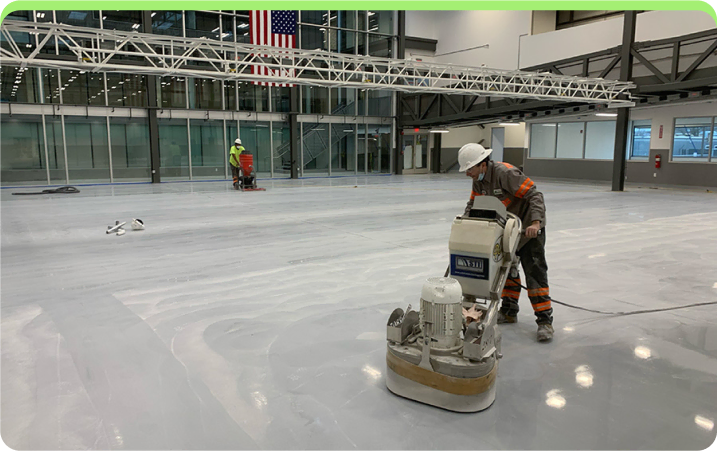
Quartz broadcast installation is a precise process where timing is critical — the quartz must be broadcast into the base coat while it is still wet enough to accept the aggregate but not so wet that the quartz sinks too deep. Here is how a professional installation proceeds:
Surface Preparation
The concrete is shot-blasted to CSP 3–4, removing contamination, laitance, and old coatings. Cracks are repaired with epoxy crack filler. Moisture readings are taken — quartz systems work better than high-gloss coatings on marginally wet slabs, but active water infiltration must still be addressed first.
Primer & Base Coat
A penetrating epoxy primer is applied and allowed to tack. The colored or clear 100% solids epoxy base coat is then applied. The base coat color becomes visible in the final floor between quartz particles, so color selection here matters for the overall aesthetic.
Quartz Broadcast
Quartz aggregate is broadcast evenly into the wet base coat at a rate of 1–2 lbs per square foot for full coverage, or lighter for a partial broadcast with more base coat visible between particles. Even distribution is critical — installers work in overlapping passes to avoid thin spots that would reduce COF. The floor is then left to cure with the excess quartz sitting on top.
Excess Removal & Grout Coat
After the base coat cures, loose quartz is swept and vacuumed. A grout coat of clear or tinted epoxy is then applied to fill the spaces between quartz particles and lock everything in. This step determines how much texture remains — a thicker grout coat buries more of the quartz for a smoother result; a thin grout coat leaves maximum aggregate exposure for maximum grip.
UV-Resistant Topcoat
A polyaspartic or aliphatic polyurethane topcoat is applied as the final protective layer. This provides UV stability, additional chemical resistance, and determines the final sheen level (matte, satin, or gloss). In areas where maximum abrasion resistance is required, a second topcoat may be applied.
Quartz vs. Flake Epoxy: Which Is Right for Your Space?
Both quartz and vinyl flake are broadcast epoxy systems, but they serve different primary purposes. Here is the honest comparison:
Quartz Broadcast
- ✓Superior slip resistance (COF 0.6–0.8+ wet)
- ✓Harder surface — better for heavy equipment
- ✓Meets commercial/institutional safety codes
- ✓Better chemical and abrasion resistance
- —More industrial look — less decorative options
- —Slightly harder to clean than smooth finishes
Best for: basements, kitchens, warehouses, industrial
Vinyl Flake (Chip)
- ✓Wide range of colors and blend options
- ✓More decorative, residential-friendly aesthetic
- ✓Effective at hiding surface imperfections
- ✓Good anti-slip with anti-slip topcoat additive
- —Vinyl chips softer than quartz — less abrasion resistant
- —Does not meet industrial anti-slip codes without additive
Best for: garages, rec rooms, light commercial
See our full flake epoxy guide for everything about vinyl chip systems, colors, and garage applications.
Quartz Epoxy Flooring Costs in Toronto (2026 Estimates)
Quartz broadcast systems cost more than standard solid-color epoxy because of the additional material (quartz aggregate, extra seal coat) and installation time required. The premium is justified by the durability and safety performance gains.
| Application | Cost per sq ft (CAD) | Notes |
|---|---|---|
| Residential basement | $8 – $14 | Standard quartz broadcast system |
| Commercial warehouse / loading dock | $10 – $18 | Heavy-duty system, industrial topcoat |
| Commercial kitchen / food service | $12 – $20 | Code-compliant, chemical-resistant topcoat |
| Custom color quartz blend | +$2 – $5 / sq ft | Dyed or blended aggregate upcharge |
Use our cost calculator for a precise quote based on your area and application.
See quartz epoxy on your own floor
Upload a photo of your garage or basement and preview real flake blends and metallic colours in seconds, before you book anything.
Try the Floor VisualiserQuartz Epoxy Flooring FAQ — Toronto Homeowners & Facility Managers Ask
Is quartz epoxy actually non-slip, or is it just marketed that way?
Quartz broadcast epoxy is genuinely slip-resistant — it is not marketing. The hardness of quartz (Mohs 7) means the aggregate profile does not compress or wear flat under traffic the way softer materials do. A properly installed quartz broadcast system achieves a COF (coefficient of friction) of 0.6 or higher in wet conditions, which meets the ANSI A326.3 standard for slip resistance in commercial wet areas. Anti-slip additives in standard topcoats achieve lower COF values and wear down over time; quartz aggregate does not. This is the core reason institutional and industrial clients specify quartz rather than additive-based systems.
Is quartz epoxy good for Toronto basements with high humidity?
Yes — quartz broadcast is actually better suited to Toronto basements with elevated moisture vapor than high-gloss epoxy coatings. The textured aggregate surface profile means any vapor that pushes up from the slab can escape around the aggregate particles rather than building pressure under a solid film. However, active water seeping through the slab still needs to be addressed before any coating is applied — quartz broadcast does not waterproof the slab, it just tolerates higher residual moisture vapor better than smooth film coatings.
How long does quartz epoxy flooring last?
In residential basement applications, quartz broadcast systems routinely last 15–25 years with minimal maintenance. In commercial warehouse and industrial settings under constant forklift and pallet jack traffic, expect 10–20 years before the topcoat requires reapplication. The base quartz layer itself rarely needs replacement — it is the topcoat and seal coat that wear over time, and these can be refreshed without removing the quartz aggregate layer beneath, making maintenance significantly cheaper than a full floor replacement.
Is quartz epoxy difficult to clean in a commercial kitchen or food service environment?
The textured surface of quartz broadcast requires slightly more attention than a smooth epoxy floor, but it is not difficult to clean in practice. In commercial kitchens, the floor is typically scrubbed with a floor machine (rotary scrubber) and a commercial degreaser rather than just mopped. The aggregate texture gives the scrubber bristles something to work against, which actually makes the cleaning more effective for removing embedded grease than a smooth surface would be. For daily maintenance, sweeping and wet mopping with a pH-neutral cleaner is all that is required. The seamless, grout-free surface means no areas for bacteria to accumulate — a key advantage over ceramic tile in food service.
Can quartz epoxy be applied over an existing epoxy floor?
In some cases, yes — but only if the existing epoxy coating is fully adhered, clean, and in sound condition. The existing surface must be abraded (diamond-ground or sanded) to give the new primer a mechanical bond. Delaminated, blistered, or peeling sections must be ground off completely before overcoating. In practice, most commercial quartz installations start with a full surface preparation back to bare concrete because this provides the most reliable long-term adhesion and is worth the extra prep cost on projects that will be under demanding commercial traffic.
What color options are available for quartz epoxy in Toronto?
Natural quartz comes in tones ranging from off-white and beige to medium grey, dark grey, and tan. Dyed quartz aggregates extend the palette to charcoal, red, blue, green, and black. The base coat color (applied beneath the quartz broadcast) is also visible between particles and contributes to the overall floor tone. The most practical approach for commercial applications is to choose a natural quartz tone that complements the wall colors and matches the facility's colour scheme — decorative impact is secondary to function for quartz systems. For spaces where both safety and aesthetics matter (upscale showrooms, boutique gyms, wellness centers), blended quartz colors create a polished, professional look while maintaining full slip-resistance performance.
Explore Related Epoxy Styles
Quartz epoxy is one of several high-performance finishes we offer in Toronto. Compare and explore:
Metallic Epoxy Flooring
A decorative, high-gloss metallic finish for showrooms, garages, and luxury interiors.
Metallic Epoxy Flooring Toronto →Anti-Slip Basement Epoxy
Safety-focused epoxy systems for Toronto basement floors with high moisture exposure.
Anti-Slip Epoxy Basement Toronto →Flake Epoxy Garage Floor
Multi-colour vinyl flake broadcast systems — a versatile, durable garage favourite.
Flake Epoxy Garage Floor Toronto →Get Safe, Durable Quartz Epoxy Flooring in Toronto
Whether you need a compliant commercial kitchen floor, a safer wet basement, or a heavy-duty warehouse surface, our Toronto team specifies and installs the right quartz broadcast system for your application and traffic load.
View examples in our gallery. Explore basement epoxy or commercial options.