Anti-Slip Epoxy Basement Floor Toronto: Safety Additives & Installation (2026)
A standard high-gloss epoxy floor is one of the most slip-prone surfaces in a Toronto home when it gets wet — and Toronto basements get wet. Condensation in summer, tracked-in moisture from rain and snow melt, laundry room spills, sump pump discharge areas — the conditions that make basements useful are exactly the conditions that make glossy floors dangerous. This guide covers every anti-slip option available for basement epoxy in the GTA, who needs which level of traction, and what it costs. Get a free quote today.
Why Toronto Basements Are High-Slip-Risk Environments
Slip-and-fall accidents are among the most common causes of household injury in Canada, and basement floors are disproportionately involved. Several Toronto-specific conditions combine to create elevated risk:
- •Seasonal moisture cycling: Toronto summers bring high humidity that causes condensation on cold basement concrete and epoxy surfaces — especially near exterior walls and windows. The resulting film of moisture on a high-gloss surface can reduce the coefficient of friction (COF) to below safe thresholds.
- •Tracked-in water from winter: From November through April, wet boots, melting snow melt, and road salt solution are regularly tracked into basement entry areas, laundry rooms, and mudrooms. Salt solution is more slippery than plain water on a glossy epoxy surface.
- •Utility area spills: Basement laundry rooms, utility sinks, and mechanical rooms regularly see water on the floor. Standard epoxy in these areas without an anti-slip treatment is a liability, particularly for elderly residents or anyone in socks.
- •Rental and insurance considerations: Toronto landlords with basement apartments or finished rental units have a duty of care to provide reasonably safe flooring. A slip-and-fall on an unprotected glossy floor in a rental unit can create significant liability exposure. Anti-slip treatment is a low-cost protective measure.

Anti-Slip Additive Options: Choosing the Right Level of Traction
Not all anti-slip treatments are the same. The right option depends on how wet the area gets, what type of footwear is worn, and how important it is that the surface is easy to clean. Here are the three main approaches used in Toronto basement epoxy installations:

Aluminum Oxide Grit
The most aggressive anti-slip option. Aluminum oxide is broadcast into the wet topcoat at a rate of 4–8 oz per 100 sq ft. Achieves COF values of 0.7–0.9 wet. Best for basement stairs, utility rooms, and any area that is regularly wet. Slightly harder to clean than smoother finishes.

Quartz Broadcast
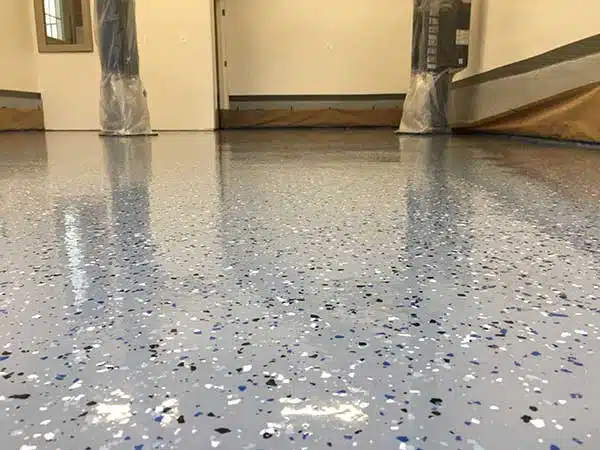
Fine quartz aggregate broadcast into the base coat at full or partial coverage. The Mohs 7 hardness means the texture does not wear flat under traffic. COF values of 0.6–0.8 wet. Popular for basement rec rooms and laundry areas where both safety and a cleaner appearance are priorities. Learn more in our quartz epoxy guide.
Polymer / Shark Grip Additive
Fine polymer beads mixed directly into the topcoat before application. Creates a subtle texture that is nearly invisible but provides measurable traction improvement over a plain gloss surface. COF values of 0.5–0.6 wet. Best for finished basement living areas where aesthetics matter and the floor is only occasionally wet.
Which Anti-Slip Option Is Right for Your Basement Area?
| Area | Recommended Additive | Reason |
|---|---|---|
| Basement stairs | Aluminum oxide (heavy broadcast) | Highest fall risk — maximum grip required |
| Laundry / utility room | Aluminum oxide or quartz broadcast | Regular water on floor from washer/utility sink |
| Basement entry / mudroom | Quartz broadcast or aluminum oxide | Wet boots, snow melt, road salt |
| Rec room / living area | Polymer grit additive | Light traction needed, aesthetics important |
Anti-Slip Epoxy for Basement Stairs: Special Considerations
Basement stairs are the highest-risk surface in any home — falls on stairs cause serious injuries and they are among the most frequently involved surfaces in home accident claims in Ontario. Epoxy on stairs requires specific treatment beyond what is applied to the floor.
Stair Tread Application
Stair treads receive a heavier broadcast of aluminum oxide than the main floor — typically 6–10 oz per 100 sq ft compared to 4–6 oz on the floor. The front 2–3 inches of each tread (the leading edge) may receive a stripe of heavier broadcast where foot contact is most concentrated. Risers are typically coated with the same epoxy system but at lighter or zero additive since they are not weight-bearing surfaces.
Nosing Treatment
The nosing — the front edge where the tread overhangs the riser below — is the highest-wear point and the most likely place for a foot to slip. Professional installers apply the thickest epoxy build here and ensure the anti-slip aggregate is densely packed at the nosing profile. On concrete stairs, nosing profiles can also be built up with epoxy mortar to create a defined, visible edge that is easier to see.
Anti-Slip Epoxy Installation for Toronto Basements

Anti-slip epoxy installation in a Toronto basement follows the same preparation steps as any epoxy coating — the critical difference is in the topcoat stage, where the additive application method determines how much traction is achieved.
Moisture Testing & Prep
Basement moisture readings are taken before any work begins. Toronto basements regularly test above the threshold for standard epoxy primers. If RH is elevated, a moisture-mitigating epoxy primer is specified instead of a standard primer. Active water infiltration through cracks or walls must be repaired before coating.
Shot-Blasting & Crack Repair
The concrete is mechanically prepared to CSP 3–4. Cracks are filled with epoxy injection or flexible polyurethane filler. High spots are ground flat. The surface is vacuumed and inspected before primer application.
Primer & Base Coat
A moisture-resistant or moisture-mitigating epoxy primer is applied and allowed to cure. The 100% solids epoxy body coat is then applied at the specified color. For quartz broadcast systems, the aggregate is applied at this stage before the body coat gels.
Anti-Slip Topcoat Application
For aluminum oxide or polymer grit systems, the additive is either mixed directly into the topcoat or broadcast into the wet topcoat immediately after application. Broadcast rate is adjusted to the target COF level for each area. Stairs may receive a heavier broadcast rate than the main floor within the same installation.
Final Seal (Optional)
For broadcast systems (quartz or aluminum oxide), a final thin clear topcoat may be applied over the aggregate to lock particles in and improve cleanability without significantly reducing the COF. This step is optional and reduces the texture level slightly — your installer will advise based on the area's use.
Anti-Slip Epoxy Basement Costs in Toronto (2026)
Anti-slip treatment adds a modest premium over standard epoxy installation — the cost difference is the additive material and the additional application step. Compared to the cost of a single slip-and-fall incident, it is one of the highest-value upgrades in a basement flooring project.
| Scope | Cost per sq ft (CAD) | Notes |
|---|---|---|
| Standard epoxy + polymer grit additive | From $10 | Subtle texture, living areas |
| Epoxy + aluminum oxide broadcast | From $10 + broadcast media | Utility rooms, laundry, entries |
| Quartz broadcast system (full floor) | $10 – $16 | Maximum traction, industrial look |
| Stairs (per stair tread) | $45 – $90 / tread | Heavy aluminum oxide broadcast |
| Moisture barrier primer upgrade | +$3 – $6 / sq ft | Required for elevated RH slabs |
Use our cost calculator for an accurate basement-specific quote.
Anti-Slip Basement Epoxy FAQ — Toronto Homeowners Ask
Will anti-slip epoxy work in a Toronto basement that has seasonal condensation?
Yes — and this is exactly the scenario anti-slip epoxy is designed for. Summer condensation on basement floors is one of the most common sources of slip risk in GTA homes. A quartz broadcast or aluminum oxide treated floor maintains its COF value when wet, so condensation moisture does not reduce traction to a dangerous level the way it does on a high-gloss untreated surface. The key is using the right primer for the slab's moisture conditions — elevated humidity basements need a moisture-mitigating primer to prevent delamination, regardless of the anti-slip treatment on top.
How much does the anti-slip texture affect how the floor looks?
The visual impact depends heavily on which additive is used. Fine polymer grit additives are nearly invisible — the floor looks like a standard gloss or satin epoxy but has improved traction. Aluminum oxide broadcast is more noticeable, giving the surface a matte, slightly rough appearance that reads as "industrial" or "commercial." Quartz broadcast falls between the two — visible texture but a cleaner look than aluminum oxide. For finished basement living spaces, polymer grit or light quartz broadcast are the best balance of safety and aesthetics. For stairs and utility rooms, the more aggressive aluminum oxide broadcast is worth the rougher appearance.
Can anti-slip epoxy be added to an existing epoxy floor?
Yes, with the right preparation. An existing epoxy floor that is fully adhered, clean, and in sound condition can have an anti-slip topcoat applied over it. The existing surface needs to be lightly abraded (diamond-ground or sanded) to give the new topcoat a mechanical bond. If the existing coating is delaminating, blistering, or significantly worn, it should be fully removed before re-coating. Adding anti-slip treatment to an existing basement epoxy floor is a common retrofit when a family's safety needs change — for example, when an elderly parent moves in, or after a near-miss slip incident.
Is anti-slip epoxy harder to clean than a standard gloss floor?
Textured surfaces are inherently slightly harder to sweep and mop than smooth surfaces because dust and debris settle into the texture rather than sliding away easily. The practical difference is minimal for polymer grit additives but more noticeable for heavy aluminum oxide or quartz broadcast systems. A stiff-bristle broom or vacuum handles debris in textured floors well. Wet mopping with a microfiber mop and pH-neutral cleaner is sufficient for most basement applications. In high-use commercial kitchens, a rotary floor scrubber is used, but that is overkill for residential basements. The cleaning trade-off is worth it — the anti-slip treatment is permanent and the cleaning adjustment is minor.
Does the anti-slip grit wear down over time and need reapplication?
Quartz and aluminum oxide are both extremely hard materials (Mohs 7 and 9 respectively) that do not wear flat under normal residential foot traffic. The aggregate itself will outlast the topcoat. What does wear over time is the topcoat that locks the aggregate in place — as the topcoat thins, the aggregate profile becomes more exposed rather than less, which actually temporarily increases traction before the aggregate eventually begins to loosen. When a topcoat refresh is done every 5–10 years, the installer can assess whether the aggregate density is still adequate or needs supplemental broadcast. Polymer grit additives mixed into the topcoat are renewed each time the topcoat is reapplied.
Is anti-slip epoxy required by building code for Toronto basement suites?
Ontario's Building Code (OBC) and Toronto's zoning regulations for secondary suites and basement apartments require that floors be safe and well-maintained, but they do not specify a particular COF value for basement floor finishes in residential settings. However, common areas in multi-unit residential buildings (corridors, stairwells) are subject to accessibility and safety standards under the OBC that effectively require slip-resistant surfaces. For landlords with basement rental units, anti-slip epoxy treatment is a practical measure to reduce liability exposure, even where it is not explicitly mandated. For commercial basement spaces in Ontario, the Ontario Food Premises Regulation and OHSA general duty provisions may apply.
Make Your Toronto Basement Safe & Stylish Today
The right anti-slip treatment for your basement depends on the areas involved, the moisture conditions, and your family's specific safety needs. Our Toronto team assesses, recommends, and installs the correct system — from light polymer grit for living areas to heavy aluminum oxide for stairs and utility rooms.
View real examples in our gallery. Explore more basement epoxy or compare to polished concrete.